


The future of IDE in Process Automation - Interview with Dr. Christian Linn

Sebastian Dietrich
Christian, it’s great to have you back for another conversation. There are several topics we want to touch on today, but we’d like to focus especially on user interaction, interfaces, and UI in the context of process automation. From your perspective, what should organizations be preparing for as we move toward 2026?
Christian Linn
Gerne! Ich denke auch, es gibt einige neue Trends zu besprechen.
Sebastian Dietrich
When we talk about process automation, we often have to revisit terminology that has been used for years. One example is the concept of the citizen developer. How relevant is it today from your point of view? Is it still something you encounter frequently in the market, or has its importance faded?
Christian Linn
The citizen developer is a concept that has evolved over the past few years and across different domains. At its core, it’s about enabling people without formal programming or software engineering training to develop applications. In principle, that idea has merit, but not across all use cases or application areas.
As with many topics in the IT and technology space, expectations were very high when the concept first gained attention. Over time, however, those expectations have only been partially met. The reason is relatively straightforward. There are scenarios where applications created through Low-Code approaches by citizen developers can work well and deliver value. However, once we move into business-critical, complex processes and systems, these approaches quickly reach their limits.
What ultimately matters is not how fast an application can be clicked together, but whether it is based on a scalable, secure, and maintainable architecture, and whether there is a sound software concept behind it. This is where citizen developer approaches often fall short.
Sebastian Dietrich
Another concept that appears frequently, especially in external communication when tools are positioned as beginner-friendly, is graphical drag-and-drop interfaces. On the other end of the spectrum, we now see the emergence of vibe coding, which works with natural language and AI. Are these two extremes, or do they simply address different user groups?
Christian Linn
They primarily address different user groups, even though the underlying goal is quite similar. Both approaches aim to significantly reduce the time required to develop software applications.
Low-Code approaches with graphical user interfaces tend to appeal more to citizen developers, but they can also support professional developers in certain scenarios by enabling faster implementation. Vibe coding, on the other hand, is a relatively new approach where software development is guided by AI through natural language or voice input.
Both approaches come with advantages and limitations. In practice, especially in the context of process automation and enterprise software, the reality will likely settle somewhere in between.
Sebastian Dietrich
If these approaches shorten the path from idea to application for different target groups, that’s clearly attractive. At the same time, applications and architectures still need to be validated and optimized. Does this mean we’ll see a resurgence of Pro-Code development, or does it simply highlight that without deep coding expertise, we can’t fully understand the bigger picture?
Christian Linn
That question is closely related to whether we will still need software developers who are able to write code. My answer is very clear: yes, absolutely.
Vibe coding tools and coding assistants primarily help accelerate code writing and application development. Where they still struggle, and where deep expertise remains essential, is in architecture and technical design. This includes modularization, complex system design, and understanding how an application behaves as part of a larger ecosystem.
Writing code is only one aspect of software development. These tools can support that part very effectively. However, when it comes to business-critical software, you need the experience to design robust architectures, ensure security, performance, and long-term maintainability. That expertise cannot be replaced.
What we will likely see is that AI-supported coding starts to challenge traditional Low-Code approaches. Simple applications, demos, proofs of concept, and prototypes can already be created extremely quickly through natural language interfaces. In many cases, this is even faster than what classic Low-Code tools can offer. I do expect a noticeable shift in that direction.
Sebastian Dietrich
So looking ahead to 2026, would you say we’re moving toward a sweet spot between Low-Code and professional, Pro-Code frameworks?
Christian Linn
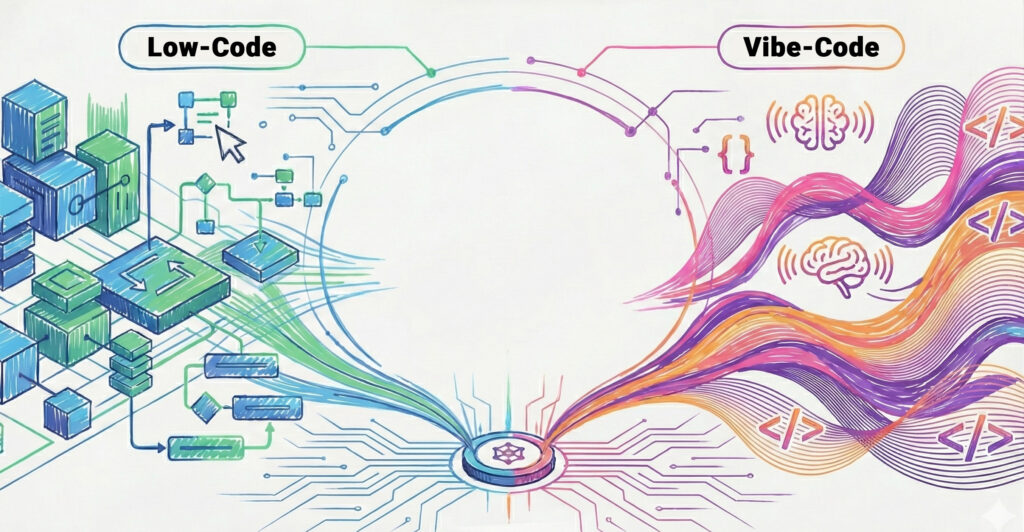
I think it’s helpful to differentiate between three distinct areas. Traditional Low-Code approaches are well suited for applications with limited criticality, especially when there is sufficient governance and compliance in place to operate them safely within a corporate environment. In those cases, they can be a good way to implement departmental use cases.
Vibe coding, on the other hand, is particularly strong in demos, proofs of concept, and prototypes. It enables teams to validate ideas quickly, gather feedback, and iterate. That makes it very effective for early-stage exploration.
When we talk about productive enterprise systems, including central IT systems and core business processes, we still need a combination of AI-supported code generation and hands-on Pro-Code development. The expertise of experienced software developers remains essential to ensure that these systems meet the requirements of enterprise IT infrastructures.
Sebastian Dietrich
If we look across all levels, from platform vendors to end users building small applications, we know that development itself is only part of the work. A large share of the effort goes into debugging and testing. Is this an area where AI agents are already delivering clear added value?
Christian Linn
Absolutely. AI already supports many different phases of the software lifecycle. We’ve talked a lot about development, such as code generation, test generation, documentation, and translating requirements into technical specifications.
Beyond that, AI and AI agents are increasingly supporting the operational side of software. This includes monitoring, error analysis, and in some cases even autonomous debugging. In certain scenarios, AI can identify issues, correct them, and redeploy updated versions of software automatically.
There are many areas where AI agents are already providing real value in software operations. This is also a direction in which we plan to further expand the Scheer PAS platform in 2026..
Sebastian Dietrich
So in short, agentic AI brings more control and support, rather than simply producing outputs without oversight.
Christian Linn
Exactly. In enterprise software, development is only one part of the equation. Operation and maintenance are just as critical. If AI can support both areas while still allowing organizations to retain control, then it becomes truly valuable.
Sebastian Dietrich
That’s a great way to wrap it up. Thank you, Christian.