


Agentic AI in Process Automation: Review of 2025 and Outlook for 2026
Interview with Dr. Christian Linn, Head of Development at Scheer PAS
1. Agentic AI 2025: From Experiment to Platform Capability
Question: Looking back at 2025: Which developments in the field of Agentic AI for process automation were the most impactful for you as Head of Development?
Dr. Christian Linn:
2025 was exciting for us in two dimensions: from our customers’ perspective and from a technological perspective.
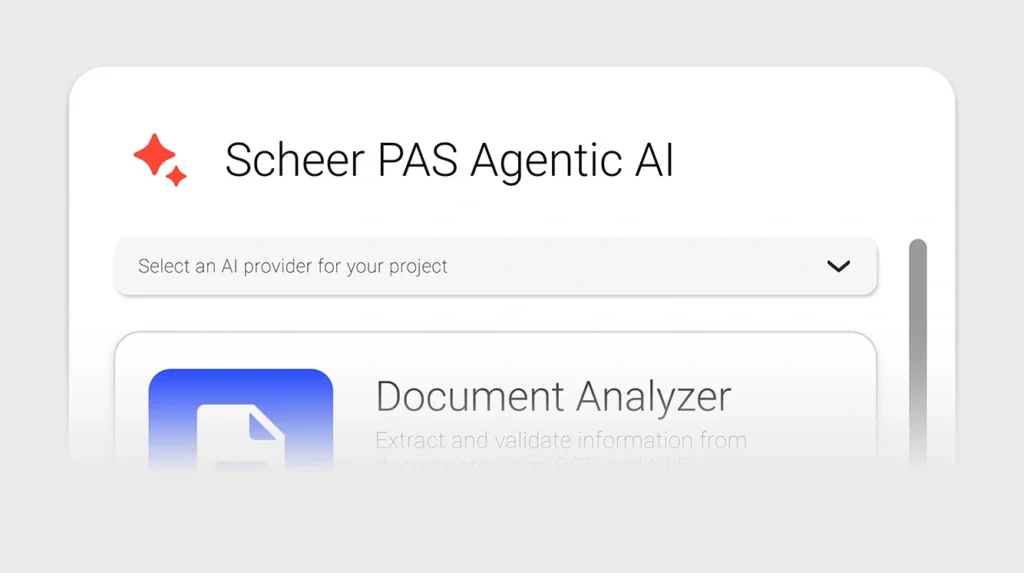
On the product side, we introduced a new feature to the Scheer PAS platform that enables our customers to build their own AI agents and integrate them into their process automation—either for complete processes or selectively for sub-processes. This was an important step: moving away from pure assistant scenarios toward agents that actually take over tasks and assume execution responsibility. This gives our customers significantly more dynamic and flexible automations.
At the same time, there was a lot of movement on the technological side. Of course, new and more powerful models from the major providers emerged. But more decisive for us was the shift in focus within the Agentic AI space: away from “let’s quickly build an agent” toward “how do we make agents truly production-ready.” Topics such as security, traceability, and transparency of execution have moved much more into the foreground. These are exactly the aspects required to deploy agents in more critical process environments—and aspects we have considered in Scheer PAS from the very beginning.
2. “Nice Demo” or Real Scalability?
Question: Many companies experimented with AI agents in 2025. From your perspective, what made the difference between “nice demos” and truly scalable process automation?
Dr. Christian Linn:
We saw many projects where an initial agent prototype was quite impressive—but failed to make the leap into continuous productive operation. Based on our experience in process automation, there are a few clear reasons for this.
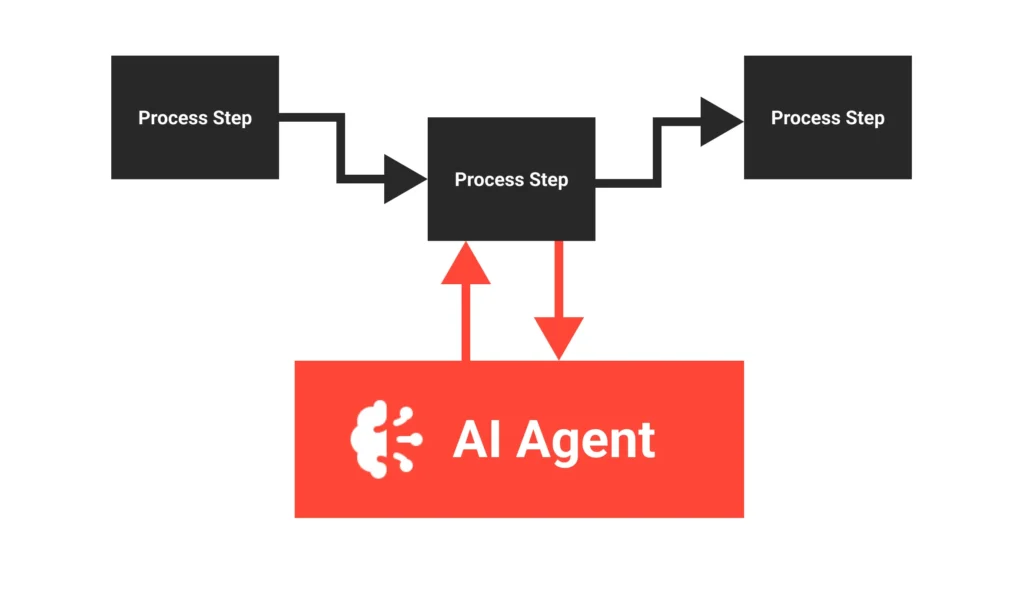
A key success factor is not viewing the agent’s use case in isolation.A key success factor is not viewing the agent’s use case. An agent never operates in a vacuum. It is always part of a business process. That means: What happens before the agent? Which systems provide context? What happens afterward, once the agent has completed its task? Who intervenes if something goes wrong?
This brings two points into play:
- Deep system integration:
Agents must be able to integrate in a controlled manner into existing IT systems. Only if they can access relevant data and functions—via stable APIs and well-defined interfaces—does real value emerge beyond the demo stage. - Robust orchestration and governance:
We see BPMN-based orchestration as an important anchor of stability. Processes remain transparently modeled, even when agents make dynamic decisions. In addition, clear governance rules are required: Which actions is an agent allowed to execute? Where are approvals required? Which data is the agent allowed to see?
And one more thing: companies need realistic expectations of LLMs such as Mistral. AI agents are not a silver bullet. There are scenarios where they are very helpful—and others where classic, rule-based automation is perfectly sufficient. The projects that successfully went into productive operation in 2025 found this balance.
3. Orchestrating Multiple Agents: The Critical Challenges of 2025
Question: From a product and architecture perspective: Which challenges in orchestrating multiple AI agents were most critical for you to solve in 2025?
Dr. Christian Linn:
We clearly assume that in many scenarios, multiple agents will work together. The key question is: How do you orchestrate this interaction reliably?
Currently, we see two main approaches:
- Multiple agents are embedded into a rule-based process structure , for example BPMN processes. The sequence, handover points, and escalation paths are clearly modeled.
- A multi-agent framework handles the coordination itself: a higher-level agent or an LLM controls which agent takes over which part of a task.
Both approaches have potential but place high demands on product and architecture. In 2025, the following challenges were particularly critical for us:
- Coordination and context propagation:
Agents must know which step of the overall process they are in and which context they are building upon. Loss of context quickly leads to wrong decisions or unnecessary loops. - Error handling and robustness:
What happens if an agent cannot execute a task, a system is unavailable, or unexpected data is received? Robust error paths, automatic fallbacks, and test scenarios are essential here. - Security and permissions:
Classic enterprise topics such as authorization management do not become less important with agents—quite the opposite. We must clearly define which agent has access to which data, systems, and actions.
At Scheer PAS, we worked intensively throughout 2025 to map these aspects into the platform: from model-based orchestration to monitoring and logging, all the way to role and permission models for agents. Only in this way can agents truly be deployed at scale in large, critical processes.
4. From Pilots to End-to-End: Priorities for 2026
Question: Looking ahead to 2026: In your view, what will be the most important priorities for users who want to move from isolated AI pilots to end-to-end process automation with Agentic AI?
Dr. Christian Linn:
For 2026, I see four central priorities:
- Selecting suitable use cases:
Not every process is immediately a candidate for Agentic AI. Companies should start with clearly defined, business-critical yet manageable processes where the added value of AI is obvious—such as high manual effort or many exceptions. - Standardizing data and APIs:
Without clean data models and well-documented APIs, any agent orchestration quickly reaches its limits. Anyone who wants to scale in 2026 must lay the foundation: integration, API management, and consistent interfaces. - Defining human-in-the-loop patterns:
Humans remain an integral part of automated processes. Companies should consciously define when an agent makes decisions autonomously and when it provides recommendations that must be approved by business users. - Clear KPIs for value measurement:
To move from pilot projects to broad adoption, solid metrics are required: cycle times, error rates, manual effort, employee and customer satisfaction. These KPIs should be considered from the very beginning.
5. Practical Advice for the Agentic AI Roadmap 2026
Question: If you had to give companies one piece of practical advice for their Agentic AI roadmap for 2026, what would it be?
Dr. Christian Linn:
My advice would be: Start focused—but start.
Choose a clearly defined, professionally relevant process where real added value becomes visible. Rely on an orchestration platform like Scheer PAS that supports you in areas such as integration, security, scalability, and monitoring. Combine this platform with a well-governed LLM such as Mistral that aligns with your compliance requirements.
And then: learn from real usage. Gather experience in development, operations, and the interaction between business and IT. These experiences cannot be replaced by any upfront analysis. Those who are ready in 2026 to start simply—with a solid foundation and a clear use case—will be able to integrate Agentic AI step by step into their end-to-end processes..

The Process iPaaS
Where Process meets Integration