


Moving beyond rule-based automation: Agentic Process Orchestration
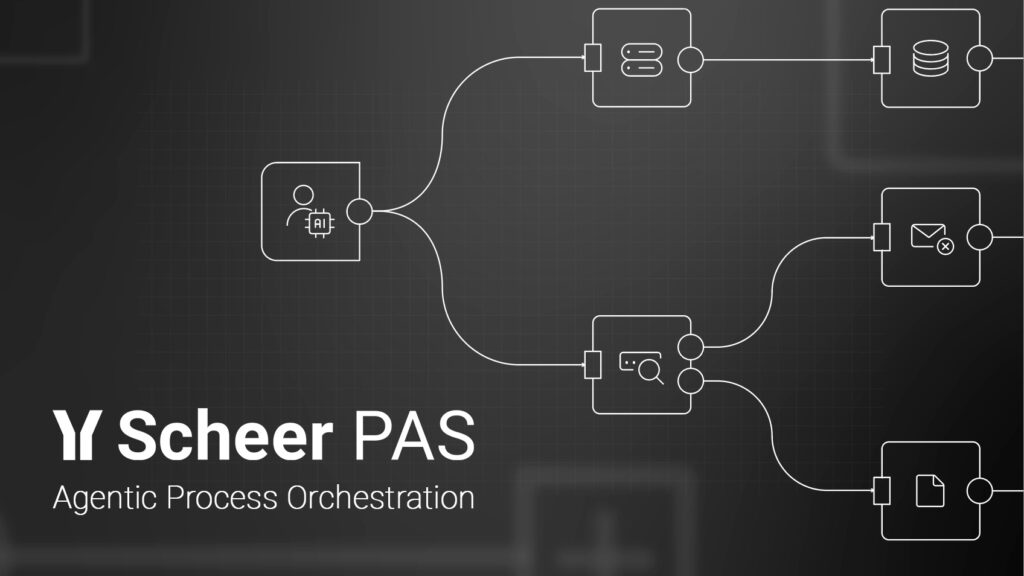
Markets, regulations, customer expectations, and supply chains are changing faster than many organizations can update their process logic. This gap has direct operational consequences: teams spend more time aligning on changes than executing work, and automation that is supposed to speed things up becomes a bottleneck. Against this backdrop, Scheer PAS has announced the launch of the Agentic Process Orchestration Platform enabling companies to orchestrate end-to-end processes with the help of autonomous AI agents. The announcement was made in Saarbrücken on March 18, 2026.
Why traditional process automation reaches its limits
Die meisten Unternehmen betreiben ihre Kernprozesse entweder auf klassischen Automatisierungsplattformen oder innerhalb von Standard-Business-Applikationen wie ERP-Systemen. Diese Umgebungen wurden vielfach modernisiert, doch das Grundmuster ist häufig gleich geblieben: Fachbereiche definieren Prozesse konzeptionell, IT setzt sie technisch um, vorwiegend als deterministische, regelbasierte Modelle. In der Praxis erzeugt diese Trennung Reibung. Abstimmungszyklen zwischen Fachbereichen und IT führen zu Verzögerungen und Missverständnissen, während fest verdrahtete Logik Prozessänderungen zu Projekten macht statt zu kontinuierlicher Verbesserung.
Das Ergebnis ist bekannt: Prozesse funktionieren gut, bis sich der Kontext ändert. Wenn neue Anforderungen entstehen, kann das System nicht in Echtzeit reagieren. Organisationen kompensieren das mit manuellen Workarounds, eskalierenden Change-Requests und längeren Durchlaufzeiten.
What agentic orchestration changes
Scheer PAS is taking a next-generation approach and enables process solutions based on AI agents.These agents use large language models to reason, plan, and execute multi-step workflows in a goal-directed manner, adapting their actions to changing conditions. Instead of encoding every decision in static rules, companies can work with goal-based execution that supports continuous optimization over time.
The platform also supports collaboration among multiple AI agents and provides a global orchestration layer for end-to-end business processes. This multi-agent coordination is intended to keep processes resilient even when exceptions occur, without sacrificing speed and transparency in operations.
Built for integration, governance, and day-to-day operations
Agentic orchestration only creates value if it can be integrated into existing system landscapes. Scheer PAS addresses this through deep API connectivity to established SaaS solutions and enterprise applications, enabling agents to access the data and process capabilities already embedded across the application landscape. Standard applications thus become reliable data and process providers, while a new orchestration layer brings deterministic and probabilistic behaviors together in a coherent flow.
The platform supports AI standards such as MCP and A2A und umfasst Funktionen für Echtzeit-Monitoring, Protokollierung und Visualisierung von Aktivitäten, Agentenverwaltung sowie einen integrierten Coding-Agent zur Unterstützung bei der Codegenerierung.
As Prof. Dr. August-Wilhelm Scheer summarizes, the future will not be shaped by static workflows alone, but by intelligent systems that reason, adapt, and collaborate.
All details about the announcement can be found in the full press release on our partner’s website: [Link to the full press release].