Automating Your Business Processes with the Power of Agentic AI
Reduce your manual tasks and speed up your development
Manual tasks take up a significant amount of work time
Current challenges:
Automation gaps
Nearly 45% of work activities slow down scaling, but these tasks could be automated with current technology stacks
Error-driven losses
Around 30% of productivity is lost due to errors in manual tasks in SMEs
Low-value work
73% of standard activities in an average business process add no real or measurable business value
From manual work to agentic process automation
Scheer PAS combines process automation, system integration, and agentic AI to eliminate manual work at scale. Instead of rigid rule-based automation, organisations utilise processes that can act, decide, and adapt within defined business and compliance boundaries.
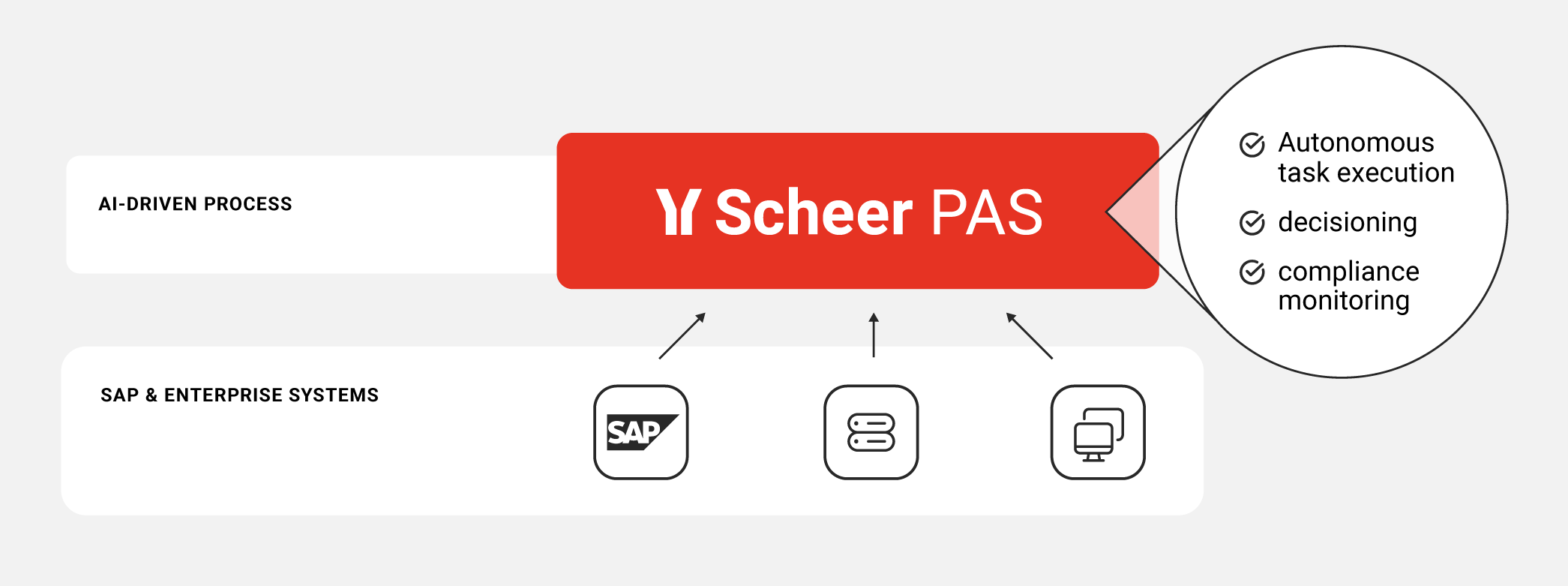
Scheer PAS integrates SAP systems (ECC and S/4HANA), legacy applications, and partner platforms into a unified process layer. Agentic AI helps coordinate actions across systems, reducing manual handovers, duplicate data entry, and fragmented ownership.
Core processes are centrally modelled and governed, while agentic AI handles variations and exceptions. These would otherwise require manual intervention, preventing the proliferation of local workarounds during scaling.
Beyond automating steps like approvals or data transfers, agentic AI evaluates context, business rules, and historical patterns to make or recommend decisions within the process flow. This reduces delays caused by human bottlenecks.
Compliance rules, validations, and audit trails are enforced directly within AI-driven workflows. Agentic AI operates within predefined guardrails, ensuring processes remain compliant even as conditions change.
Real-time visibility into process execution allows agentic AI to detect bottlenecks, predict failures, and trigger corrective actions before manual escalations and human involvement is required.
Measurable benefits and outcomes
Key metric |
Improvement |
Impact |
|---|---|---|
Work time efficiency | Manual handovers, data entry, and approval cycles are reduced through orchestrated, AI-driven workflows | 20–40% less process cycle time across core operational processes |
Reduced operational costs
| Fewer manual interventions and reduced dependency on additional headcount during growth phases
| 15–30% lower operational costs in process-heavy functions
|
Error rates
| Embedded validations and AI-assisted decisioning reduce human errors in data handling and execution
| 25–50% fewer process errors and rework cases
|
Compliance and auditability
| Rules, controls, and audit trails are enforced directly within the process flow
| Consistent compliance with significantly reduced audit preparation effort
|
Scalability | Increased transaction volumes are handled without proportional increases in staffing | Linear growth in volume without linear growth in costs |
Deploying AI-driven process automation safely
Scheer PAS is typically deployed in a phased, non-disruptive approach. It is building on existing systems rather than replacing them. Organisations start with one or two high-impact processes and expand iteratively, ensuring early results while maintaining operational stability.
Typical adoption approach
1
Process identification and prioritisation
Select processes with high manual effort, error rates, or compliance risk. Define clear KPIs to measure impact from the start.
2
Integration and process modelling
Connect SAP and non-SAP systems and model end-to-end processes in a centralised process layer. Governance rules and AI guardrails are defined upfront.
3
Automation and agentic AI enablement
Automate tasks, approvals, and decision points. Agentic AI is introduced where variability and exceptions require intelligent handling.
4
Pilot, measure, and scale
Run controlled pilots, validate outcomes against KPIs, and extend automation to additional processes, regions, or business units.
Timeframe, scalability, and governance
Initial results
Usually within weeks, depending on process complexity
Scalability
Designed to handle growing transaction volumes without increasing operational overhead
Governance
Centralised process ownership, audit trails, and AI guardrails ensure compliance, transparency, and control
One of the earliest AI automated processes in Europe
Overcoming manual plausibility checks for police reports
Saarland State Police struggled with a growing volume of routine manual work: plausibility checks for traffic-accident reports required time-consuming, error-prone processes carried out by highly qualified staff. As bottlenecks and mistakes mounted, discover how Scheer PAS helped automate these checks for 35,000+ accident reports annually.

"With this AI-aided plausibility check of accident reports, we are relieving our highly qualified staff of important but monotonous work, while at the same time ensuring high quality and efficiency. This makes our work easier despite tight personnel resources and increasing case complexity. We’re becoming even more professional."
Klaus Bouillon, Former Saarland Minister of the Interior


