BLOG
Getting That Prototype to Production…Under Control! Scheer PAS Agent Hub Now Available
18 November 2026
AI can get a team to a working prototype quickly. Turning that prototype into software a company can rely on is harder. Someone has to review it, test it, deploy it, and watch over it once it runs, and that is where many AI projects stall.
Scheer PAS Agent Hub is now available to close that gap. It is the platform for agentic engineering and agentic process orchestration. Your team builds enterprise processes, services, and AI agents in real code, with AI working inside a structure you define. You then run them in production with rules, human handovers, access control, and budgets.
Why AI-built software stalls before production
Most stalled projects run into one of four problems:
- The code the AI wrote works, but nobody on the team can maintain it.
- The tools for building, testing, and running it do not connect.
- Low-code tools get a first version out, then hit a ceiling once the process gets complex.
- Running the result turns into a project of its own.
Behind these problems sit two gaps: one is building AI software to the standards the rest of your software already meets; the other is running AI agents under control, so each one does its job inside a process the business understands.
Structured agentic engineering
Agentic engineering means AI agents write software inside a structure your team sets. In Agent Hub, that structure follows four simple steps.
- Someone describes what they need in plain language.
- The AI writes the code, the tests, and the documentation.
- The change shows up in your own code repository, where a person reviews it and accepts it.
- Accepted changes follow a defined route into production.
The code stays in your repository, so your team can read it, change it, and own it. Scheer PAS Code is the workbench where this happens.
Here is a simple example. An engineer writes: “Score the customer before approval, and send risky orders to a person.” Agent Hub adds a credit check to the order process and updates the code behind it in the same run. The tests pass, a named colleague approves the change, and it goes live. One route builds, tests, and deploys it.
An agent that acts inside a defined process
Agentic Process Orchestration is about where an agent sits once it runs. In Agent Hub, an agent is a step in a process model, the same kind of model business teams use to describe how work flows. Each agent step has a rule attached, and where the process needs human judgement, a person steps in, keeping a human in the loop.
Many processes need exact results, so Agent Hub lets you use rules and code where the outcome has to be exact, and an agent where a step needs judgement.
Take the order process example again. On its own, an AI assistant can check an order. Orchestrated in Agent Hub, the same assistant scores the customer against a defined risk threshold, hands every order that exceeds it to a named person, and leaves a record behind. For every step, Agent Hub records who did what, when, and on what basis, in a form you can hand to an auditor.
Every call to a model or a tool goes through one gateway
Agents call language models and external tools all the time, and every call costs money and may touch sensitive data. Agent Hub sends all of these calls through one Agent Gateway, where policies, guardrails and metrics are set once. Guardrails apply to every request that passes through.
From the gateway, you decide which agents can use which models, with virtual API keys managed in one place. You set a budget for each agent and cost limits for each model provider. You also see runs, token use, costs, and tool calls for each agent in one view.
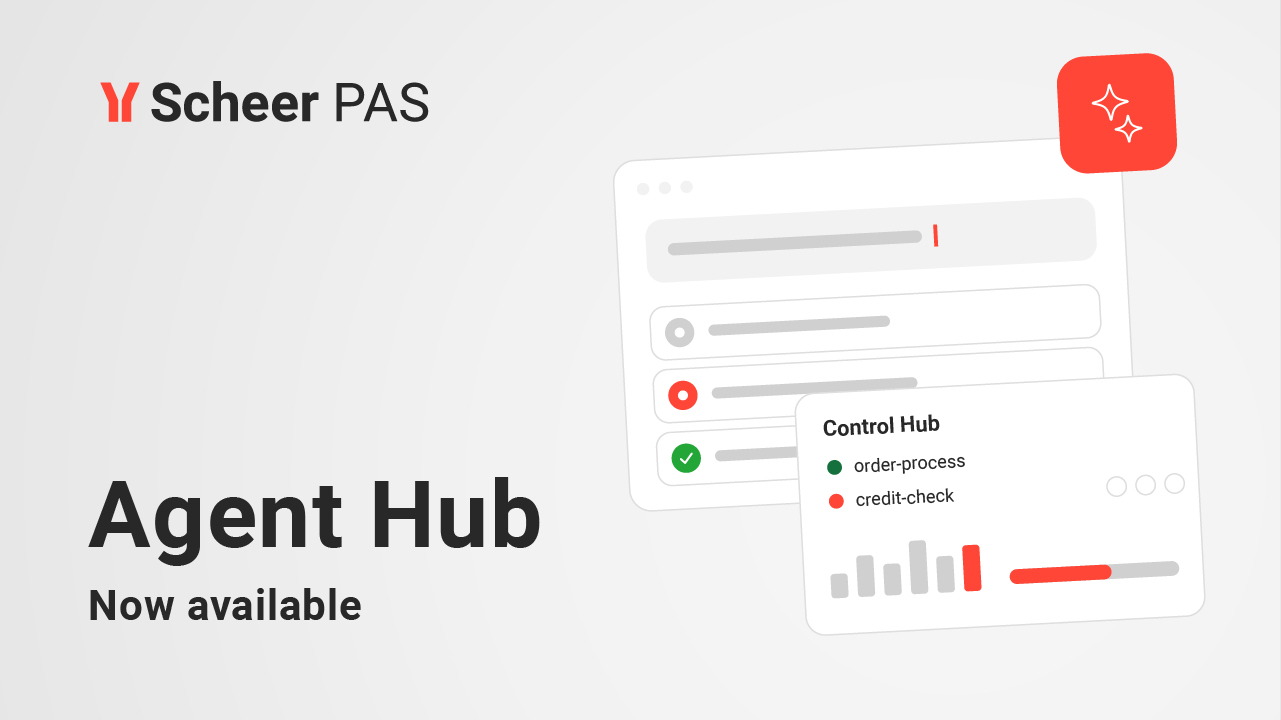
The Control Hub brings this together. It lists every deployment with its state, and beside it each agent as a service with its own address, runs and cost. Running agents stays part of the same project instead of becoming a new one.
Where agents run and which models they call is your decision
Scheer PAS can host Agent Hub for you in a sovereign European environment operated in the T-Systems Cloud. You can also run it on your own infrastructure and Kubernetes. For models, you can choose commercial vendors, European models or a model in your own data centre, and switching between them is a configuration change.
This also helps with regulation: frameworks such as the EU AI Act and NIS2 call for controlled, explainable automation, and Agent Hub’s audit trail gives you the evidence.
Built on customer projects
Agent Hub builds on years of putting AI into real processes with customers. Saarland State Police is one example. Officers had to check traffic-accident reports for plausibility by hand, which tied up highly qualified officers at a time of staff shortages. Scheer PAS built an AI-based plausibility check and connected it to the police’s existing systems. The AI now checks more than 35,000 accident reports a year, and over 80% of the checks run automatically. The full story can be found in our Saarland State Police case study.
Our Agentic AI Use Case Library holds even more processes we have built with customers.
Point it at one real process
The clearest way to see whether Agent Hub fits is to try it on one real process in your organisation. Get in touch with us to request a trial, and we can agree the conditions with you before access starts.
No developers of your own? No problem! Scheer PAS professional services can build the first use case with you. The team has delivered hundreds of development projects with customers across sectors including energy, manufacturing, media, retail, and the public sector. That experience helps you choose the right process to start with and take it all the way into production with Agent Hub.
