The Power of Rapid Low-Code Development Meets Pro-Code Customisation
Design, deploy, and scale process-driven applications faster
Application development in enterprise environments
Current challenges:
Slow delivery cycles
Enterprise application development cycles often take 6–12 months, slowing down innovation and time-to-value
Maintenance burden
30–40% of custom applications become hard to maintain due to fragmented logic and missing process documentation
Uncontrolled tools
“Shadow” IT and point solutions increase integration effort and compliance risk, especially in SAP-centric landscapes
Combining the power of pro-code with the speed of low-code development
Scheer PAS enables process-driven application development by combining low-code and pro-code tooling, centralised process orchestration, and deep SAP integration. This allows organisations to build flexible applications without losing control.
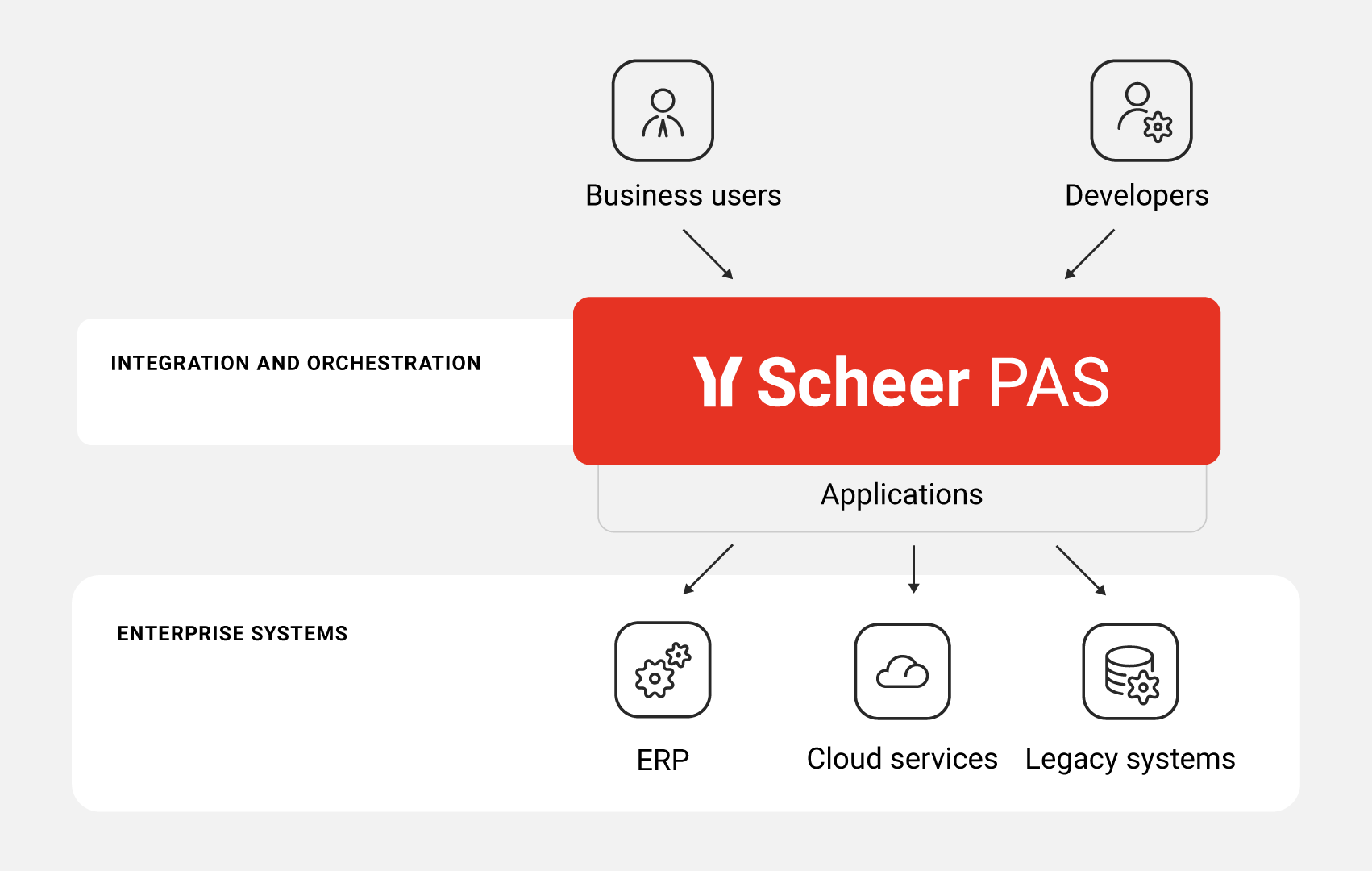
Applications in Scheer PAS are built around executable business processes. Logic, roles, and rules are transparently modelled, ensuring shared understanding between business and IT.
Reusable UI components, services, and integrations accelerate development. Business logic is configured rather than hard-coded, reducing development effort and long-term maintenance costs.
Scheer PAS connects SAP ECC, S/4HANA, and non-SAP systems into a single application flow. Data consistency and transactional integrity are preserved across systems.
Authorisation models, audit trails, and validation rules are part of the application architecture. This prevents uncontrolled changes and supports enterprise compliance requirements.
Applications can be extended or adjusted as requirements change, without rebuilding core logic. This supports continuous improvement and scalable growth.
Measurable benefits and outcomes
Key metric |
Improvement |
Impact |
|---|---|---|
Development speed | Low-code components, reusable process models, and prebuilt integrations reduce manual coding effort while still allowing Pro-code extensions and customisations where needed | 30–60% faster application delivery compared to traditional custom development |
Development and maintenance effort | Centralised process logic replaces scattered business rules across applications, reducing long-term maintenance complexity | 25–40% lower development and maintenance effort over the application lifecycle |
Business–IT alignment | Executable process models create a shared understanding between business and IT, minimising rework caused by misinterpreted requirements | Significantly fewer requirement changes and rework cycles |
Application quality and error rates | Built-in validations, standardised components, and governed change management reduce defects introduced during development | 20–50% fewer application defects in testing and production |
Scalability and extensibility | Applications can be extended via pro-code without breaking low-code foundations, supporting evolving business needs | Linear growth in functionality without linear growth in complexity or cost |
Implementation snapshot
Scheer PAS application development is implemented using a phased, enterprise-ready approach, combining fast initial results with long-term architectural stability. Existing SAP and non-SAP systems are extended, not replaced.
Typical adoption approach
1
Use case and application scope definition
Identify business applications with high manual effort, frequent changes, or integration complexity. Define success KPIs such as development time, maintenance effort, or error reduction.
2
Process modelling and architecture setup
Core business processes are modelled as the backbone of the application. Governance rules, roles, and security models are defined upfront to ensure enterprise compliance.
3
Low-code development with pro-code extensions
Applications are built using low-code components for speed, while pro-code is used where custom logic, integrations, or UI behaviour is required.
4
Integration and testing
SAP and non-SAP systems are connected into end-to-end application flows. Automated testing and validations ensure stability and data consistency.
5
Deploy, measure, and extend
Applications are deployed incrementally. Feedback and KPIs are used to continuously extend functionality without reworking the core architecture.
Timeframe, scalability, and governance
Initial results
First productive applications typically delivered within weeks, depending on scope and complexity
Scalability
Designed for enterprise-scale usage and growing transaction volumes without redesign
Governance
Centralised process ownership, versioning, audit trails, and controlled pro-code extensions ensure transparency and control
New product lifecycle management “from clay to sale”
Utilising low-code platforms to develop a new PLM process
Using Scheer PAS, one large global ceramics manufacturer has integrated their legacy systems, kept all of the dependencies in check, created a flexible development environment, and made a complete PLM application that is being used throughout their entire organisation.

“With the help of Scheer PAS, we’ve developed a complete product lifecycle management application in less time with all of our SAP standards in check.”
One of the largest ceramics manufacturers in Germany

