Govern and Orchestrate APIs Across Your Enterprise
Ensure scalable API adoption with enterprise‑grade governance, visibility, and control

API Sprawl increases risk and complexity
Current challenges:
Fragmented APIs
Large enterprises manage 500+ APIs on average, often distributed across teams without consistent governance or ownership
Limited insight
Less than 40% of organisations have centralised visibility into API usage, performance, and dependencies across the enterprise
IT security exposure
APIs have become a primary attack surface, with inadequate governance and visibility significantly increasing security and operational risk as API usage scales
Centralised API management with business process awareness
Scheer PAS provides a centralised, process aware API management layer that enables enterprises to expose, govern, and orchestrate APIs consistently – reducing risk, improving transparency, and supporting scalable integration across the IT landscape.
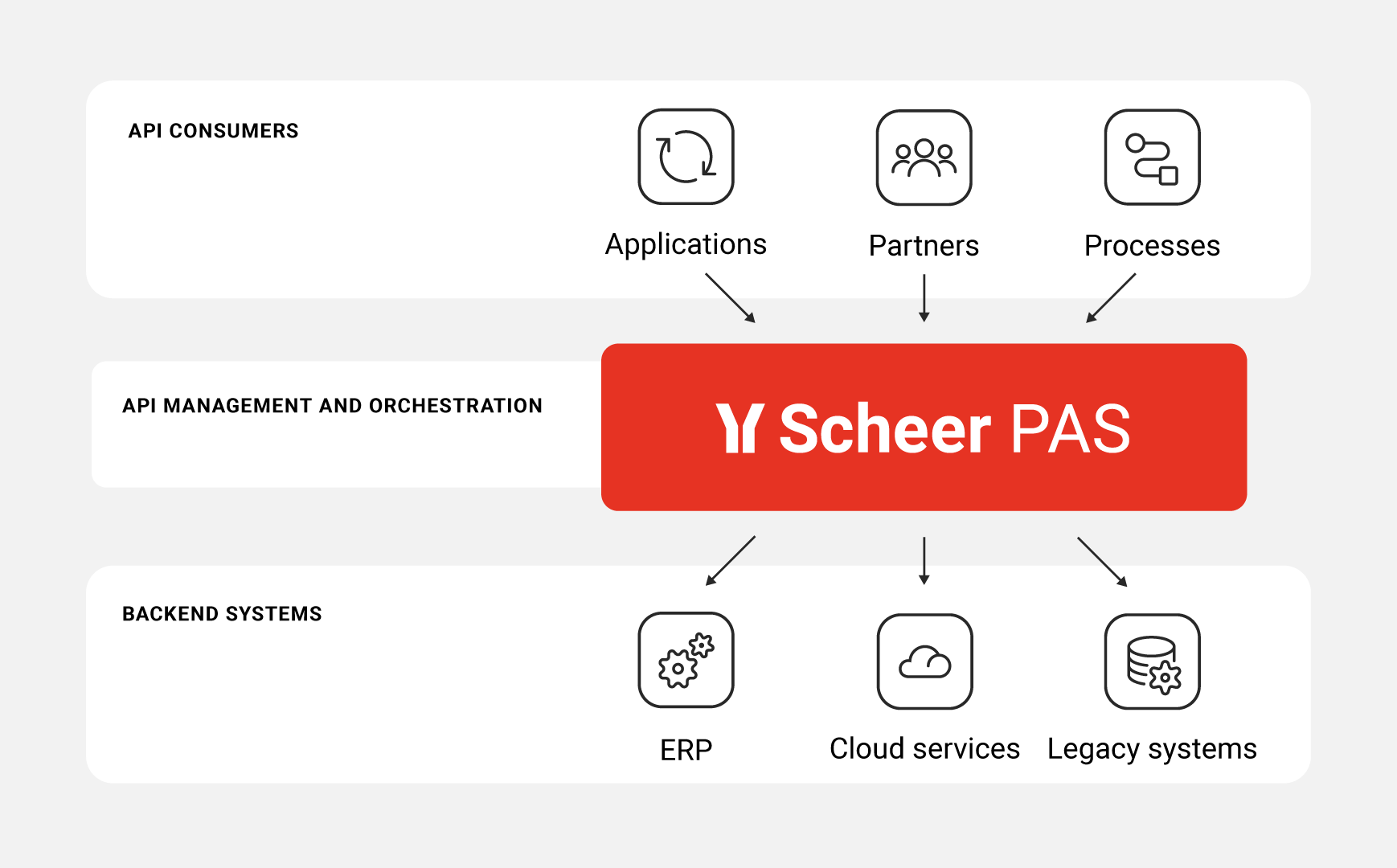
APIs from ERP systems, cloud platforms, SaaS applications, and legacy environments are exposed and consumed through a unified management layer rather than managed in isolation.
API interactions are orchestrated centrally, separating consumers from backend implementations and reducing tight coupling between systems.
Authentication, authorisation, versioning, and usage policies are applied consistently across APIs, independent of individual systems or development teams.
APIs are coordinated as part of controlled execution flows, enabling reliable sequencing, error handling, and dependency management across services.
Runtime behaviour, dependencies, and failures are monitored centrally, providing visibility beyond technical metrics into operational impact.
Measurable benefits and outcomes
Key metric |
Improvement |
Impact |
|---|---|---|
API delivery time | Reusable APIs and centralised management reduce duplicated implementation and coordination effort | 30–50% faster API rollout for new applications and integrations |
Change and maintenance effort | Decoupled consumers and governed API lifecycles reduce regression and rework | 25–40% lower API maintenance effort over time |
Operational incidents | Centralised monitoring, error handling, and dependency management reduce API related failures | 20–35% fewer API incidents impacting business operations |
Security and compliance exposure | Consistent authentication, authorisation, and policy enforcement across APIs | Reduced security risk and simpler compliance audits |
Scalability of API usage | Increasing API traffic and consumers are handled without linear growth in operational effort | Higher API throughput without proportional cost increases |
Giving you control over your APIs
Typical adoption approach
1
API landscape assessment and prioritisation
Identify existing APIs, consumers, and dependencies. Prioritise APIs with high usage, security exposure, or operational risk, and define KPIs for performance, reliability, and compliance.
2
API onboarding and standardisation
Expose selected APIs through a centralised management layer. Apply consistent standards for authentication, versioning, documentation, and lifecycle management.
3
Orchestration, security, and monitoring enablement
Configure security policies, traffic controls, error handling, and monitoring. Orchestrate API interactions to reduce tight coupling and improve resilience.
4
Pilot, measure, and scale
Run controlled pilots, validate outcomes against defined KPIs, and extend API management to additional services, systems, and consumer groups.
Timeframe, scalability, and governance
Initial results
Typically achieved within weeks, depending on API maturity and system landscape
Scalability
Designed to support growing API volumes and consumers without linear increases in operational effort
Governance
Centralised API ownership, policy enforcement, versioning, and audit trails ensure security, compliance, and architectural consistency
Managing APIs from on-premises to cloud systems
Connecting the existing legacy infrastructure through APIs
One of the largest cable network operators in Switzerland was faced with the challenge of introducing a new CRM system. While a cloud solution was chosen for the new CRM, much of the existing IT landscape, especially the central ERP system, consisted of on-premises solutions. Since strong protection of internal on-premises systems is essential for the company, a solution was sought that would securely integrate cloud CRM with on-premises ERP and allow flexible customisation to meet future needs.

"Scheer PAS enabled us to securely expose on-premises APIs to our cloud CRM while maintaining full control over access and policies."
One of the largest cable network operators in Switzerland

