Build Enterprise Process Applications Without Stitching Your Stack Together

Scheer PAS gives developers one Pro-Code environment for BPMN-based processes, Node.js services, Angular UIs, APIs, integrations, AI agents, deployment, and runtime operations.
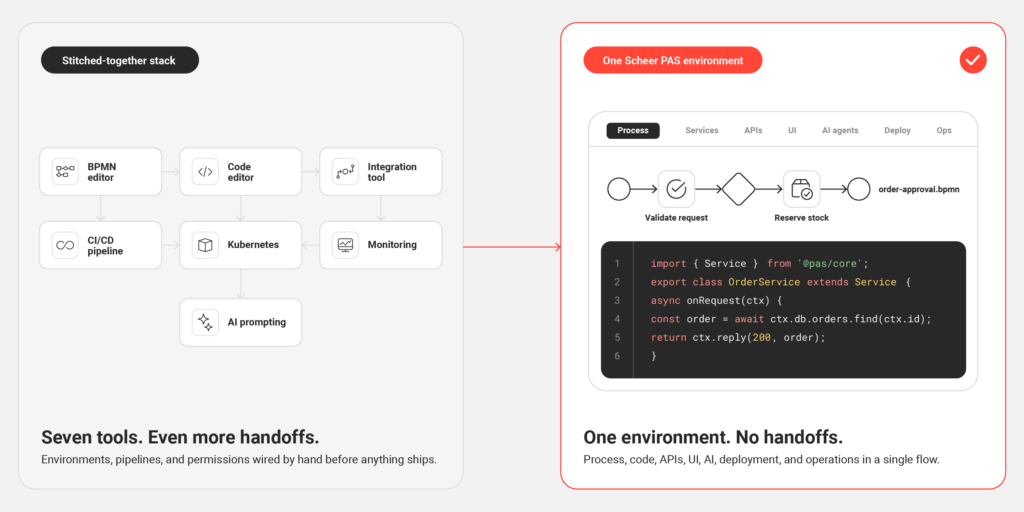
A pro-code development platform covering process, services and runtime

What developers tell us…

“We lose more time in the toolchain than in the code.”

Enterprise development is rarely blocked by a single hard feature. It slows down because process models live in one tool, implementation in another, integrations somewhere else, and deployment and operations in separate stacks again. Developers spend too much time wiring together environments, pipelines, permissions, and handoffs before they can ship anything meaningful.

“We should not have to build the platform before we build the application.”

Too many initiatives begin with the same technical groundwork: identity setup, databases, file storage, monitoring, logging, deployment configuration, scaling, governance, and operational basics. This work is necessary, but it should not delay every new project. Development teams want a production-capable foundation from the start, so they can focus on building the actual application logic.

“AI helps us move faster, but only if the output stays maintainable.”

Teams are actively experimenting with AI-assisted development, but speed alone is not enough. If generated code ignores architecture, established patterns, or service boundaries, the result is technical debt that teams have to clean up later. Development leaders need AI support that improves productivity while still fitting into a controlled engineering model.

A more practical way to build enterprise applications

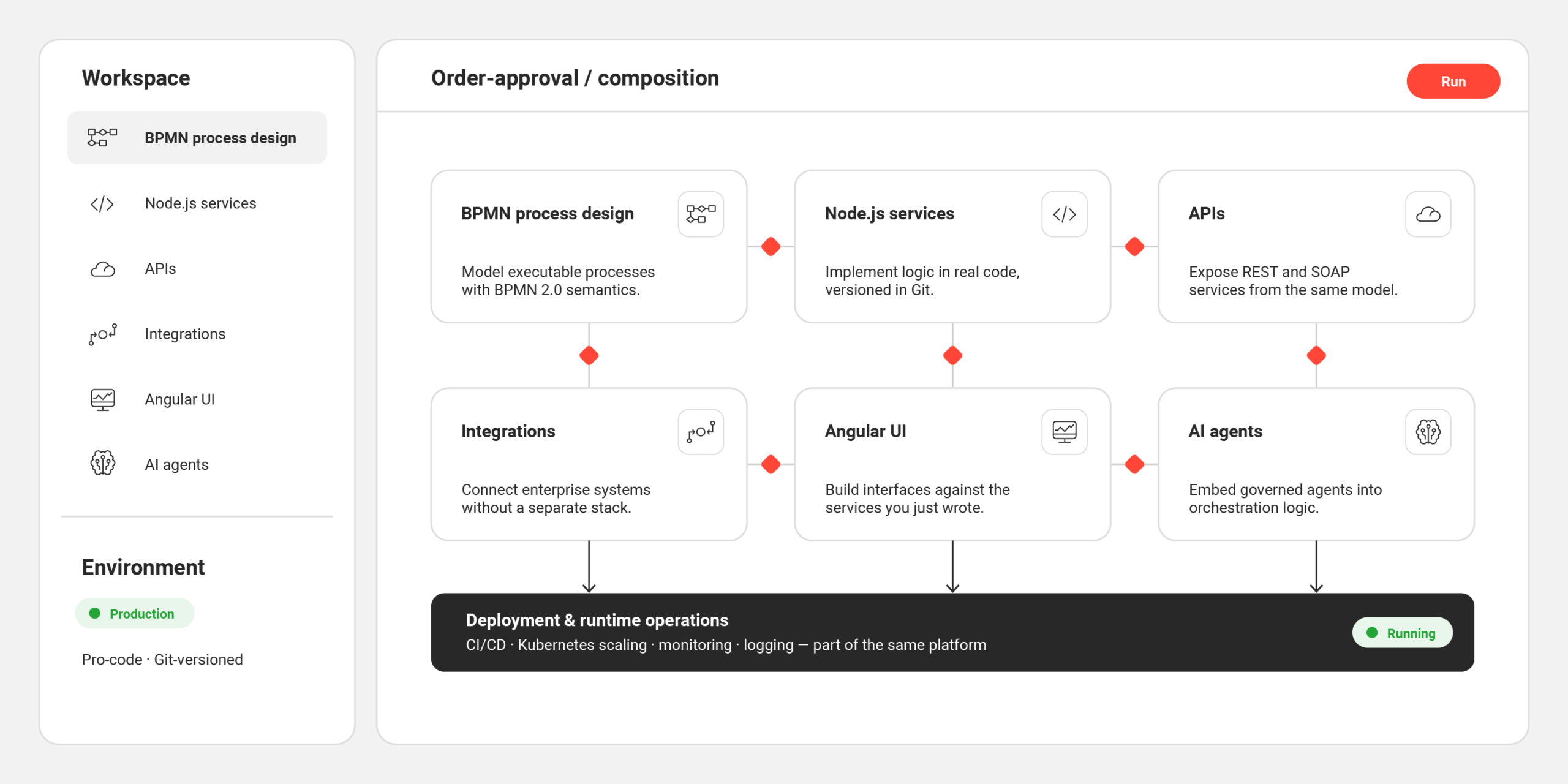
One workspace for process design, service implementation and integrations

Build the full application across one system, not five

Scheer PAS brings process design, service implementation, integrations, APIs, AI agents, user interfaces, deployment, and operations into one developer environment. Teams can model BPMN-based processes, implement logic, connect enterprise systems, expose services, and deliver working applications without jumping between disconnected tools. For developers, this removes coordination friction. For heads of development, it creates a more consistent delivery model across teams.

A BPMN process model alongside its service implementation

Keep the freedom of a Pro-Code stack

Scheer PAS is built for teams that want acceleration without abstraction. Developers work in a real Pro-Code environment with Node.js, Angular, Git, and Visual Studio Code. That means code stays transparent, versioned, reviewable, and aligned with existing engineering practices. Teams can implement complex logic directly, shape service boundaries intentionally, and fit the platform into established workflows instead of changing the entire workflow to fit the platform.

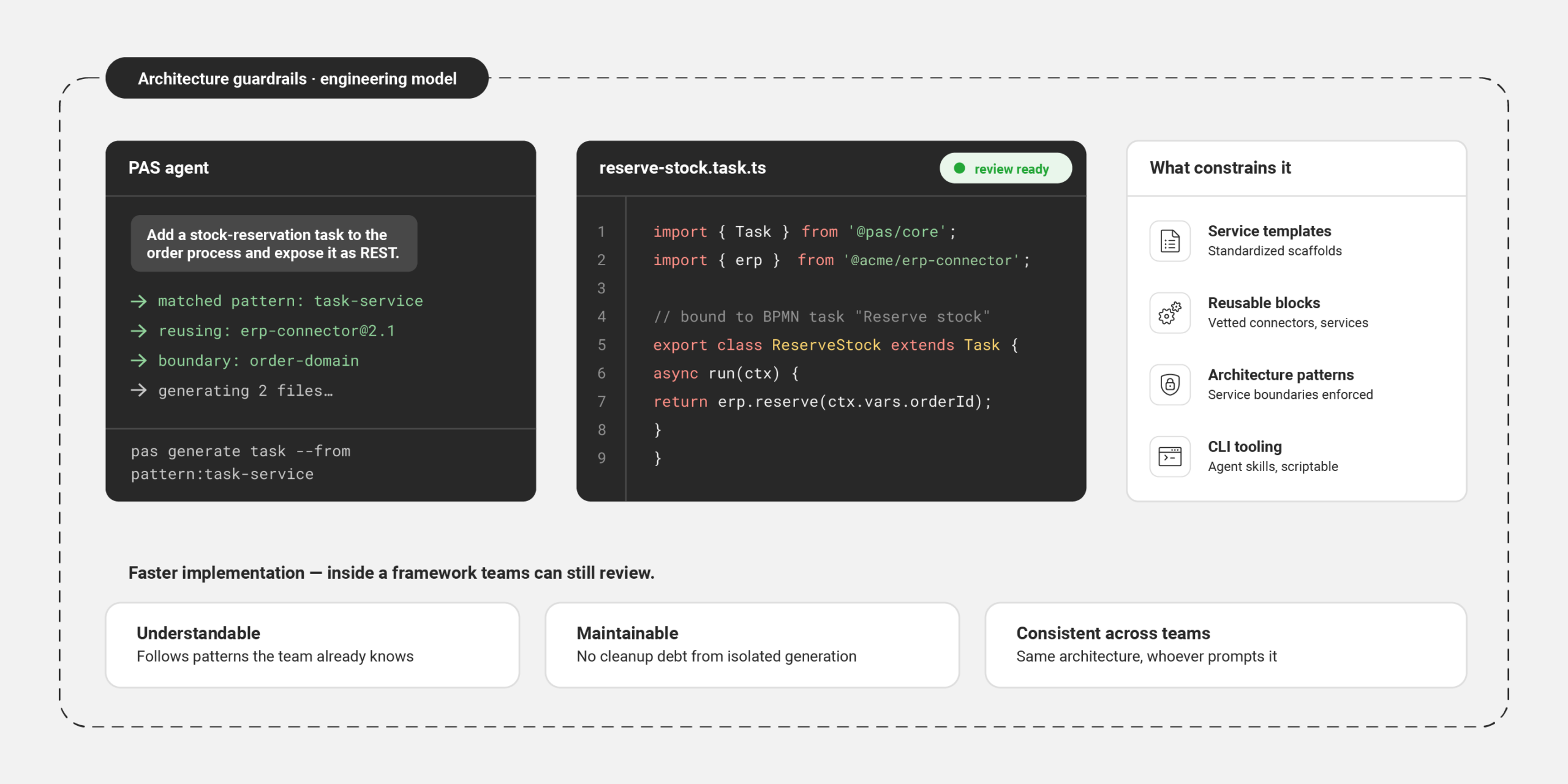
AI-assisted implementation guided by defined architecture and reusable patterns

Use AI to accelerate implementation, not to create cleanup work

Scheer PAS supports AI-assisted development through defined architecture, reusable patterns and services, and specialised agent skills with CLI tooling. The goal is not to generate code in isolation, but to speed up implementation inside a framework that teams can still understand, review, maintain, and extend. This helps developers work faster while reducing the risk of inconsistent code and uncontrolled AI output across teams.

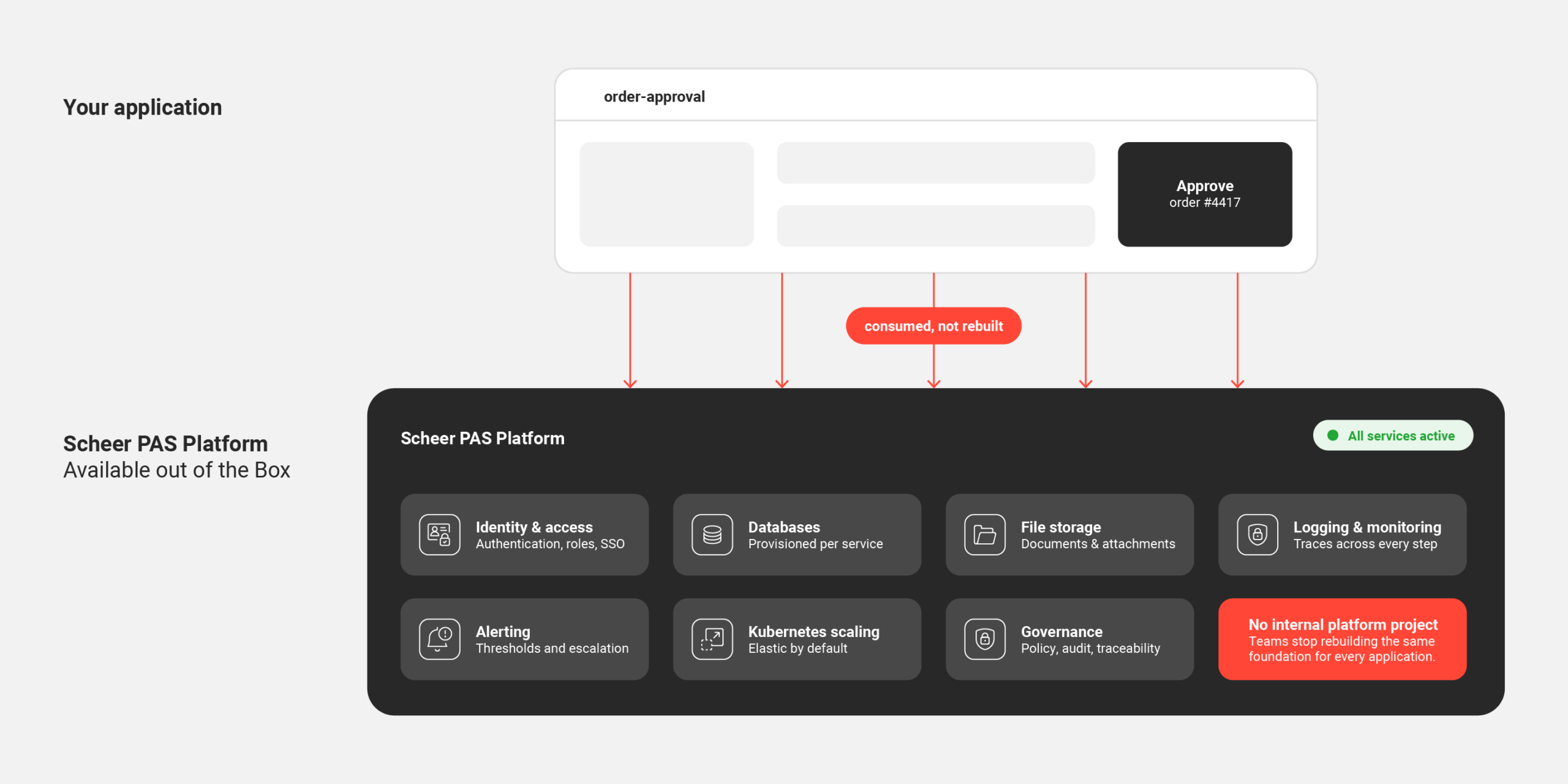
Built-in runtime services including identity, storage, monitoring and Kubernetes scaling

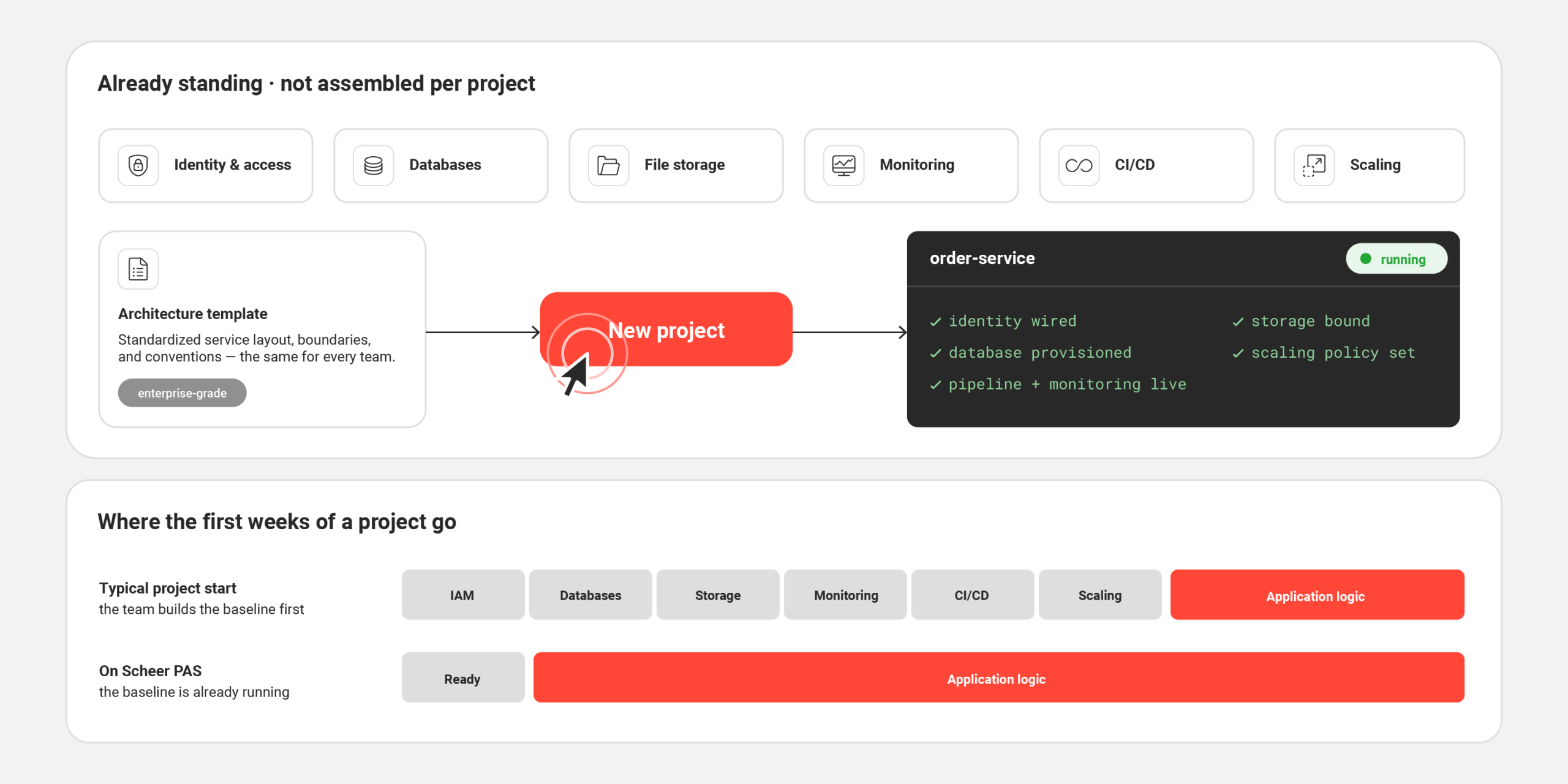
Every service starts from a solid baseline, not a blank project

Every application built with Scheer PAS runs on a standardised, enterprise-grade architecture by default. Developers do not need to define the same baseline for every project, and heads of development do not have to manage unnecessary variation across teams. Services begin with a proven technical foundation, which reduces architectural risk, shortens setup time, and makes delivery more predictable.

A new service starting from a standardised enterprise baseline

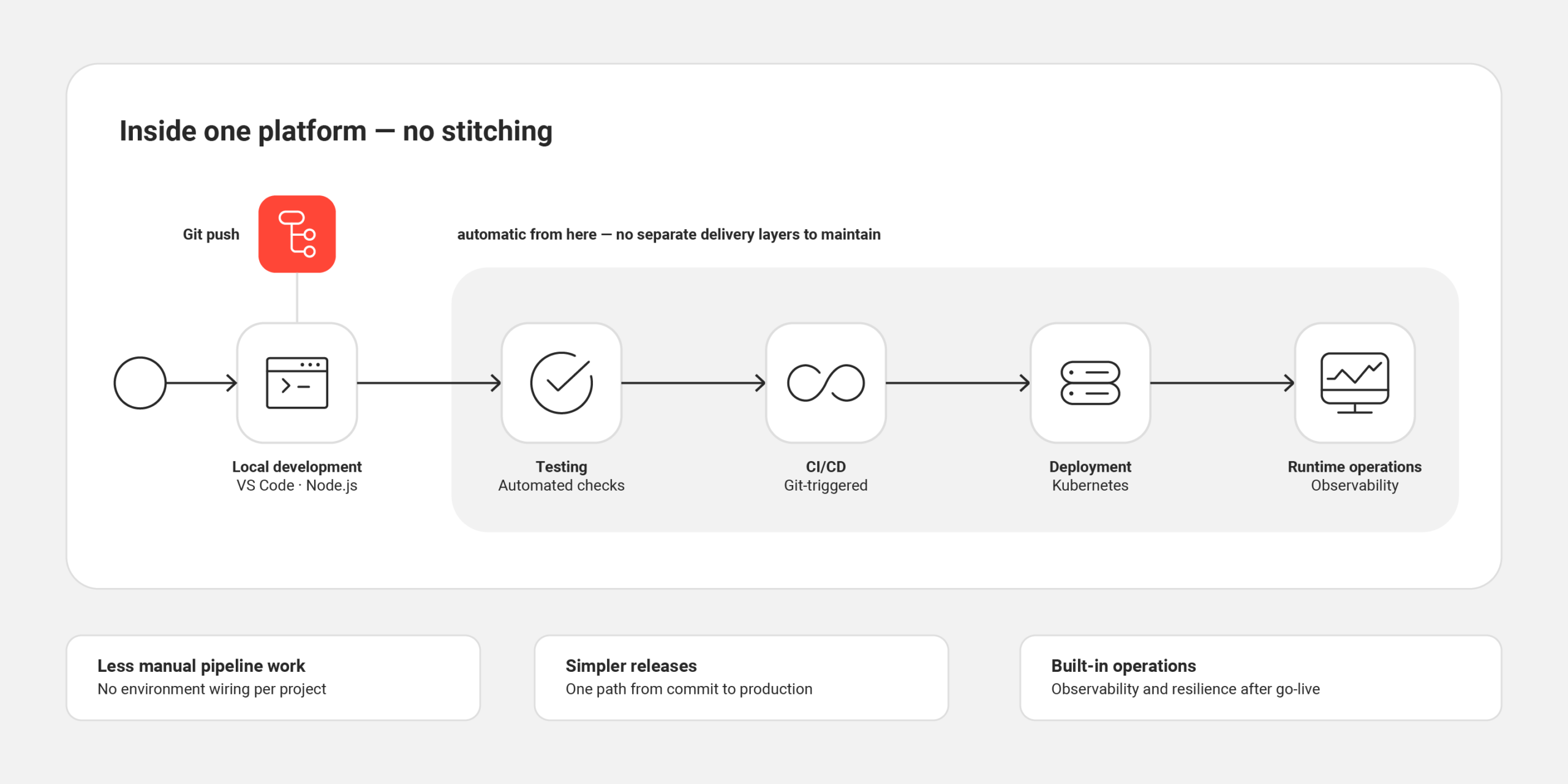
Develop locally, push changes, and let the platform handle the rest

Scheer PAS covers the full path from local development to production. Teams can develop locally, test changes, push updates, and move through CI/CD, deployment, and runtime operations without stitching together separate delivery layers. This reduces manual pipeline work, simplifies releases, and helps teams spend less time maintaining the path to production.

Local development moving through CI/CD to deployment and runtime

Use enterprise runtime services without rebuilding them per team

By including the infrastructure and platform capabilities that enterprise applications typically depend on, Scheer PAS lets teams identify and access management, databases, file storage, monitoring, logging, alerting, Kubernetes-based scaling, administration, and governance out of the box. That removes repeated setup work from individual teams and helps heads of development standardise how applications are built and operated without creating another internal platform project.

What this means for your team

With Scheer PAS, development teams work in a setup that is closer to how they actually want to build software.


Processes, services, integrations, APIs, user interfaces, AI support, deployment, and operations are connected in one environment, while the development model remains Pro-Code. This reduces setup overhead, shortens the path to production, improves consistency across teams, and makes it easier to maintain what gets shipped.


For heads of development, it also creates a more standardised foundation for architecture, delivery, and runtime operations without slowing engineers down.

Icon of three processes being streamlined into one

Reduce delivery friction

  • Build process applications, integrations, APIs, AI agents, and user interfaces in one environment
  • Eliminate handoffs between disconnected tools and reduce coordination overhead
  • Shorten the path from first implementation to production-ready delivery
  • Give teams more time for application logic instead of platform assembly
Icon showing lines of content or code being written

Keep control of code and architecture

  • Work with Node.js, Angular, Git, and Visual Studio Code
  • Keep code transparent, reviewable, and aligned with team standards
  • Implement complex requirements directly, without low-code workarounds
  • Standardise delivery without constraining engineering teams

Simplify the path to production

  • Cover local development, testing, CI/CD, deployment, and runtime operations in one flow
  • Avoid repeated pipeline and environment setup across projects
  • Use built-in observability, resilience, and operational tooling after go-live
  • Strengthen governance while expanding automation across the organisation
Icon of an AI Sparkle

Use AI in a way teams can maintain

  • Accelerate development with AI support grounded in architecture and reusable patterns
  • Reduce the risk of inconsistent or fragile AI-generated code
  • Embed AI agents into BPMN-based processes and orchestration logic
  • Keep execution traceable, auditable, and governed in production

Key customer success story for developers

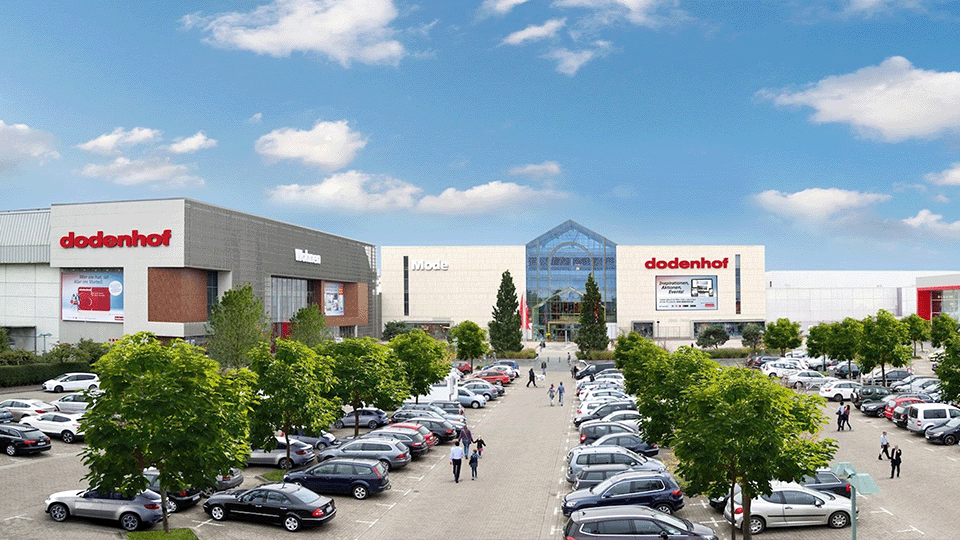
image of dodenhof shopping centre and car park

70% Faster IT integration and no-risk modernisation for dodenhof with Scheer PAS

See how dodenhof achieved leading integration agility and slashed time-to-market for IT projects transforming its complex retail landscape with Scheer PAS’ microservices, modular architecture, and safe migration strategy.

More resources

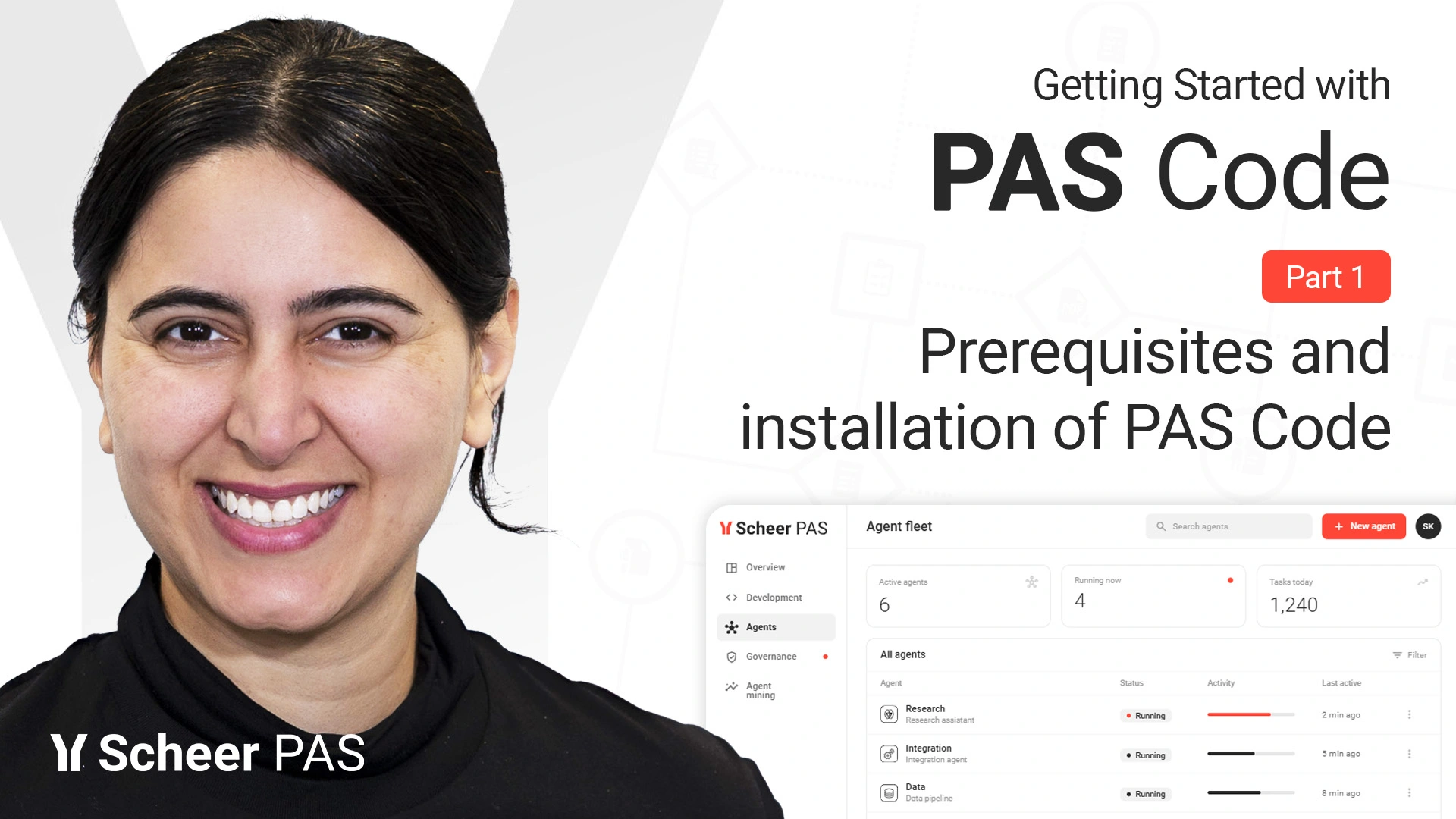
Watch Scheer PAS in action

Experience how development teams are able to build and run enterprise process applications in one environment. In this on-demand session, Scheer experts walk through process modeling, pro-code implementation, integrations, APIs, AI-assisted development, deployment, and runtime operations.
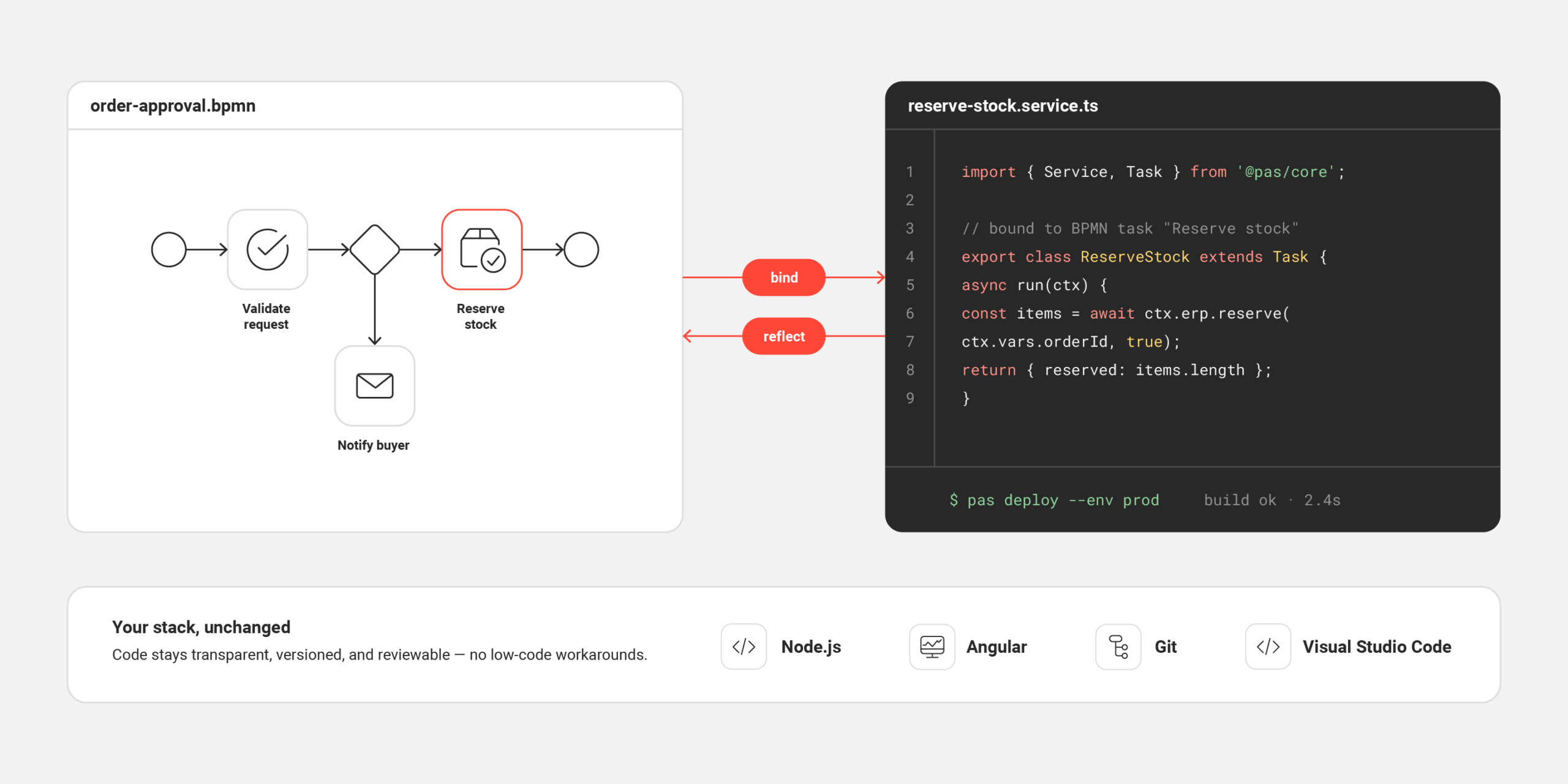
Illustration of a Pro-Code environment covering process, services and runtime
Self-check for development teams

How much of your time goes to the toolchain rather than the code?

Six short questions on toolchain, setup, delivery and AI support. Answer openly and you will see where you stand.

6 questions, about 90 seconds

Talk to an expert