Integrate and Unify Your IT Landscape
A process-centric iPaaS that connects applications, data, and people while giving you full control, governance, and transparency across enterprise integrations
A fragmented IT landscape hinders digital transformation
Current challenges:
Budget drain
Up to 50% of IT budgets are spent maintaining existing systems limiting the resources for innovation and transformation
Legacy bottlenecks
Old and unintegrated systems delay integration initiatives by weeks or even months creating bottlenecks
Limited visibility
Individual system monitoring leaves fewer than 30% of organisations with real-time visibility over their end-to-end business processes
All your systems integrated and unified on one platform
Scheer PAS addresses integration complexity by enabling integration of SAP, non-SAP, legacy and modern systems all in one platform. It enables enterprises to standardise integrations, automate cross-system processes, and gain end-to-end operational visibility.
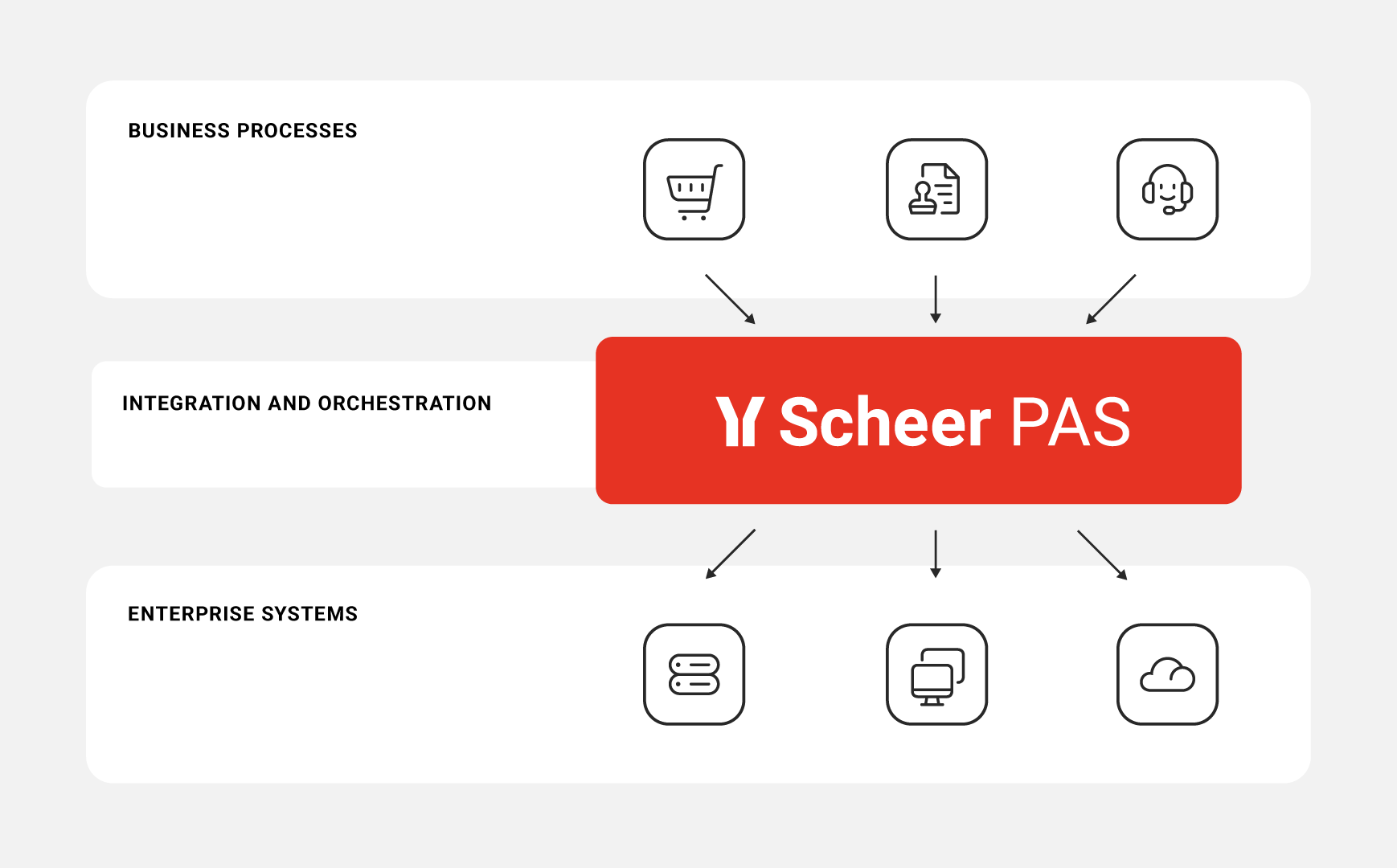
Business processes are modelled centrally and independently of underlying systems, creating a shared, business-aligned blueprint for execution.
Enterprise applications, legacy systems, and cloud services are connected through standardised integration services that are orchestrated by the process layer, not hard-coded point-to-point links.
Scheer PAS coordinates process execution across systems, services, and human tasks thus ensuring consistent sequencing, error handling, and exception management.
Business rules, approvals, and exception handling are embedded directly into processes, enabling consistent automation across organisational boundaries.
Process and integration execution is monitored in real time, providing transparency across systems, handovers, and organisational silos.
Centralised lifecycle management, versioning, and governance ensure integrations and processes remain controlled as requirements change.
Measurable benefits and outcomes
Key metric |
Improvement |
Impact |
|---|---|---|
Integration delivery time | Point-to-point integrations are replaced by reusable, process driven integration services and standardised connectors | 30–50% faster integration delivery across new and existing initiatives |
Change and adaptation effort
| Integration logic is decoupled from individual systems and managed centrally within process models
| Up to 60% faster implementation of changes across integrated systems
|
Integration maintenance effort
| Centralised orchestration, monitoring, and lifecycle management reduce troubleshooting and manual fixes
| 30–50% lower integration maintenance effort
|
Integration error rates
| Built-in validations, exception handling, and controlled execution reduce runtime failures
| 25–40% fewer integration errors and incidents
|
Scalability of integrations | Increased transaction volumes are handled through orchestration and reuse rather than additional point solutions | Higher integration throughput without linear cost growth |
Implementing process driven system integration safely
Scheer PAS is typically implemented using a phased, nondisruptive approach that integrates existing systems rather than replacing them. Organisations start with a limited number of high impact integration scenarios and expand iteratively, establishing a governed integration foundation while maintaining operational stability.
Typical adoption approach
1
Integration scope and prioritisation
Identify critical system integrations with high manual effort, frequent failures, or limited transparency. Define technical and operational KPIs to measure integration performance and stability.
2
System integration and service modelling
Connect ERP, cloud platforms, SaaS, and legacy systems using standardised integration services. Integration logic is centralised and decoupled from individual applications, with governance rules defined upfront.
3
Orchestration, error handling, and monitoring
Orchestrate message flows and system interactions across integrations. Implement centralised error handling, retries, and monitoring to improve reliability and reduce operational incidents.
4
Pilot, validate, and expand
Run controlled pilots for selected integrations, validate performance and stability, and extend the integration layer to additional systems, domains, or regions.
Timeframe, scalability, and governance
Initial results
Typically achieved within weeks, depending on integration complexity and system landscape
Scalability
Designed to support increasing integration volumes and transaction loads without linear growth in operational effort
Governance
Centralised integration ownership, versioning, monitoring, and audit trails ensure security, compliance, and control
Turning mess into profit with unified and integrated IT landscape
Rethinking IT system landscape at dodenhof
dodenhof‘s IT system became highly heterogeneous, hindering the development of their digital strategy. The absence of an integration platform led to a complex web of point-to-point connections, with the existing POS system linked to five different division-specific ERP systems. Learn how Scheer PAS paved the road to unified and integrated IT systems.

“Through the longstanding successful cooperation, Scheer PAS is not just a service provider who operates a technical system for us. As a partner, Scheer PAS has become part of dodenhof - just like the software solution.”
Alexander Giehoff, Project and Process Manager at dodenhof